
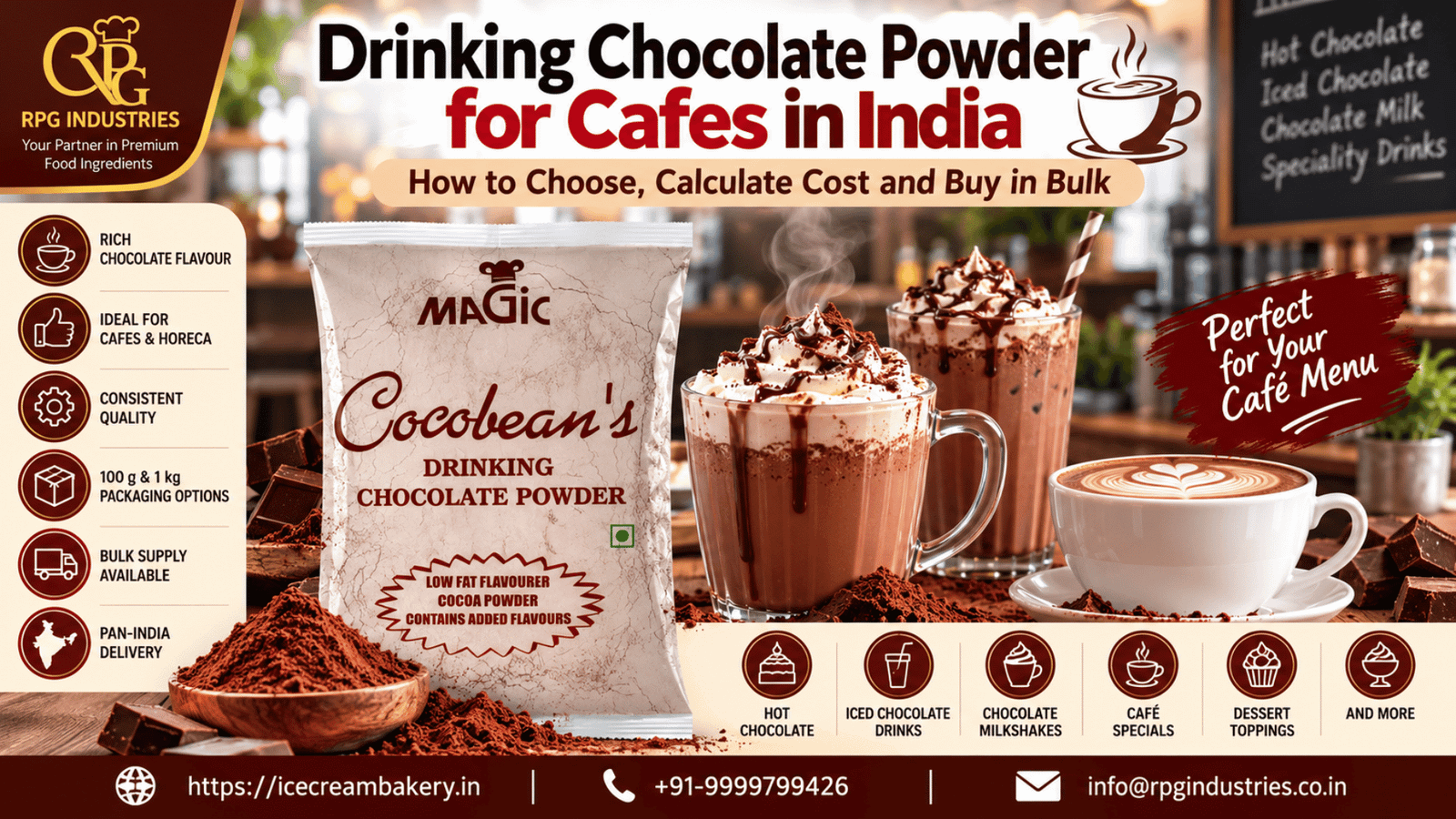
Drinking Chocolate Powder for Cafes in India: How to Choose, Calculate Cost and Buy in Bulk
Drinking chocolate powder for Cafes should be selected based on flavour, sweetness, preparation performance, cost per serving, and supply reliability. For café owners, coffee shops, restaurants, hotels, and commercial beverage businesses, the right product should suit the menu, work with the intended preparation method, and fit the purchasing budget.
RPG Industries offers Magic Drinking Chocolate in 100 g and 1 kg packaging options, according to its published product listing. Café operators can evaluate the product against their recipes, serving requirements, and commercial needs before placing an order.
This guide explains how to choose drinking chocolate powder, compare it with cocoa powder, calculate cost per cup, estimate monthly consumption, test samples, and evaluate bulk suppliers in India.
What Should Cafes Look for in Drinking Chocolate Powder?
Cafes should evaluate drinking chocolate powder using six criteria: flavour, sweetness, mixing behaviour, recipe compatibility, cost per serving, and packaging availability. These factors help buyers determine whether a product suits their beverage menu and daily operations.
| Evaluation factor | What to check | Why it matters |
| Chocolate flavour | Intensity, taste, and sweetness in the finished drink | Helps match the product to the café’s menu |
| Formulation | Ingredient declaration, allergens, and stated cocoa content where applicable | Clarifies what the product contains |
| Mixing behaviour | Dispersion in the intended liquid and preparation conditions | Helps assess preparation performance |
| Recipe compatibility | Suitability for the café’s intended beverages | Determines which applications are practical |
| Cost per serving | Powder cost at the tested dosage | Supports beverage costing |
| Packaging and supply | Pack sizes, availability, delivery terms, and minimum order quantities | Helps with stock and purchasing decisions |
The best drinking chocolate powder is not necessarily the cheapest product per kilogram. A café should compare products using the same recipe and preparation method, then consider flavour, performance, and actual cost per serving.
What Is the Difference Between Drinking Chocolate Powder and Cocoa Powder?
Drinking chocolate powder is generally formulated for chocolate beverages, whereas cocoa powder is primarily a cocoa-derived ingredient used in beverages, baking, and other food applications. Their compositions vary, so the ingredient declaration and preparation instructions should guide the purchasing decision.
| Product | Primary purpose | What café buyers should consider |
| Drinking chocolate powder | Chocolate-based beverages | Check sweetness, formulation, and preparation instructions |
| Cocoa powder | Beverages, baking, and food preparation | Additional sweetening or formulation may be necessary |
| Hot chocolate mix | Convenient preparation of hot chocolate | Check the ingredients and preparation directions for the specific mix |
For example, a café seeking a convenient chocolate beverage ingredient may prefer a product formulated for drinking. A café developing its own chocolate recipe may prefer cocoa powder and control sweetness and other ingredients separately.
The right choice depends on the intended recipe, desired flavour, preparation workflow, and total beverage cost.
Which Café Beverages Can Use Drinking Chocolate Powder?
Depending on the product formulation and preparation instructions, drinking chocolate powder may be suitable for several beverage applications.
- Hot chocolate: A chocolate beverage prepared using the recommended liquid and mixing method.
- Chocolate milk: A milk-based chocolate drink, provided the product is suitable for the intended serving temperature.
- Iced chocolate drinks: Cold beverages prepared with a powder that disperses appropriately under the chosen conditions.
- Signature café beverages: Custom chocolate drinks featuring milk, toppings, or other complementary ingredients.
Cafes should test each application before adding it to the menu. A powder that performs well in a hot beverage may behave differently in cold milk, so cold preparation should be evaluated separately.
How Should Cafes Test Drinking Chocolate Powder Before Bulk Purchasing?
Cafes should test shortlisted drinking chocolate powders using the same recipe, equipment, liquid, and serving conditions. This creates a fair basis for comparing products before committing to a large order.
Follow this practical evaluation process:
- Prepare a standard recipe. Use the same liquid, serving size, and equipment for every sample.
- Measure the powder. Record the quantity used for each trial.
- Evaluate flavour. Assess chocolate intensity, sweetness, and overall taste.
- Check mixing behaviour. Observe dispersion, clumping, and texture under the tested conditions.
- Record preparation time. Determine how easily staff can reproduce the recipe.
- Calculate ingredient cost. Use the actual supplier quotation and tested dosage.
- Repeat the test. Check whether different staff members can achieve a comparable result.
A simple scorecard can help purchasing teams compare flavour, mixing behaviour, preparation time, and cost. The selected product should meet the café’s minimum quality requirements while remaining commercially viable.
This is a recommended testing method, not a claim that a specific RPG Industries product has passed these trials.
How Much Does Drinking Chocolate Powder Cost per Café Serving?
The powder cost per serving depends on the purchase price per kilogram and the quantity used for each drink.
Formula:
Powder cost per serving = (Price per kg ÷ 1,000) × Grams used per serving
For example, assume a hypothetical purchase price of ₹400 per kg.
| Powder used per drink | Illustrative powder cost per drink |
| 20 g | ₹8 |
| 25 g | ₹10 |
| 30 g | ₹12 |
These are illustrative calculations, not RPG Industries’ quoted prices or recommended serving quantities. The appropriate dosage should be established through product instructions and recipe testing.
The powder cost is only one part of the total beverage cost. Cafes should also account for milk, toppings, cups, labour, utilities, and preparation losses before determining menu prices.
How Much Drinking Chocolate Powder Does a Café Need Each Month?
Monthly powder consumption depends on the number of drinks sold, grams used per serving, and operating days.
Consider a café selling 40 chocolate drinks daily over 30 days, equivalent to 1,200 drinks per month.
| Powder per drink | Monthly drinks | Monthly powder requirement |
| 20 g | 1,200 | 24 kg |
| 25 g | 1,200 | 30 kg |
| 30 g | 1,200 | 36 kg |
These figures are planning examples rather than recommended dosages. Actual requirements will vary with sales, recipes, and wastage.
This calculation helps café owners estimate purchasing quantities, compare pack sizes, and request supplier quotations based on expected demand. Keeping a record of consumption and delivery lead times can also help establish practical reorder points.
Where Can Cafes Buy Drinking Chocolate Powder in Bulk in India?
Cafes can source drinking chocolate powder from food ingredient manufacturers and wholesale suppliers. Buyers should compare product specifications, sample availability, packaging, minimum order quantities, commercial pricing, and delivery terms before selecting a supplier.
RPG Industries is a B2B food ingredients manufacturer and bulk supplier. Its published product listing identifies Magic Drinking Chocolate in 100 g and 1 kg packaging options and states a shelf life of two years. Buyers should confirm current availability, product specifications, and storage requirements directly with the company before ordering.
Visit the RPG Industries Drinking Chocolate Powder product page to review the product offering and enquire about purchasing requirements.
Before requesting a quotation, estimate your monthly consumption and identify the pack size that suits your storage capacity and purchasing cycle. Ask the supplier whether samples are available and request relevant product documentation.
For product enquiries: Email info@rpgindustries.co.in or visit icecreambakery.in.
What Should Café Owners Ask a Drinking Chocolate Powder Supplier?
Before confirming a wholesale order, café owners should clarify the product specifications and commercial terms.
| Question to ask | Why it matters |
| What is the product formulation? | Helps assess ingredients, allergens, and suitability |
| Are samples available? | Allows testing before bulk purchasing |
| What pack sizes are offered? | Helps match packaging to consumption |
| What is the minimum order quantity? | Clarifies the initial purchasing commitment |
| What is the declared shelf life? | Supports stock rotation and purchasing plans |
| What are the delivery terms? | Helps manage replenishment and operating costs |
| What quality documentation is available? | Helps meet the buyer’s product and compliance requirements |
Request relevant technical information and verify details before placing an order. For Cafes with regular beverage demand, reliable supply and appropriate stock planning are as important as the initial purchase price.
Choose Drinking Chocolate Powder That Fits Your Café’s Needs
Choosing drinking chocolate powder for Cafes requires more than comparing prices per kilogram. Buyers should evaluate flavour, preparation performance, cost per serving, monthly consumption, and supplier reliability before making a purchasing decision.
RPG Industries offers Magic Drinking Chocolate in the packaging options specified on its published product listing. Café owners, restaurant operators, and commercial beverage buyers can view the product details or email **info@rpgindustries.co.in** to enquire about their requirements.
Explore RPG Industries Products Range
Choco Paste Manufacturer | Cocoa Powder Manufacturer | Butterscotch Crunch Manufacturer | Custard Powder Manufacturer | Baking Powder Manufacturer | Corn Flour Powder Manufacturer | Chocolate Syrup Manufacturer | Cake Decorating Sprinkle Manufacturer | Icing Sugar Powder Manufacturer | Chocolate Chips Manufacturer