
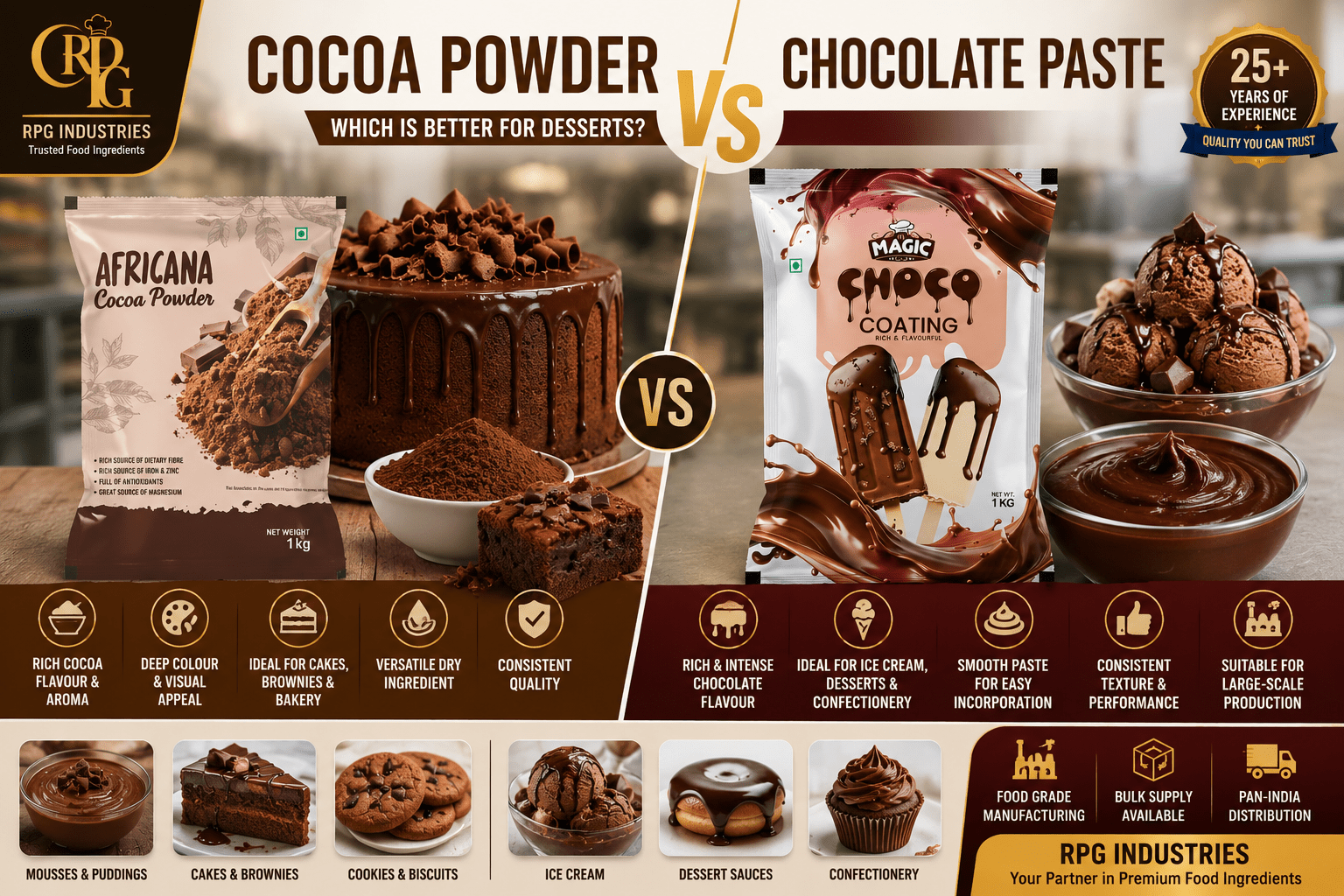
Quick Summary: Cocoa Powder vs Chocolate Paste
Cocoa powder and chocolate paste are different food ingredients and should not automatically be treated as 1:1 substitutes. Cocoa powder is a dry cocoa ingredient commonly used to provide chocolate flavour, colour and cocoa solids, while chocolate paste is a prepared chocolate ingredient used in applications such as desserts, ice cream and confectionery. The better choice for commercial desserts depends on the recipe, desired flavour and colour, formulation, processing method and production requirements.
Cocoa Powder vs Chocolate Paste: Which Is Better for Commercial Desserts?
Cocoa powder and chocolate paste are not universally interchangeable. Cocoa powder is a dry ingredient that provides cocoa flavour, colour and cocoa solids, while chocolate paste is a prepared chocolate ingredient designed for incorporation into specific food formulations.
For commercial desserts, the better option depends on the application. Bakeries may prefer cocoa powder for cakes and brownies, while chocolate paste can be useful in ice cream, desserts and other formulations where a prepared chocolate ingredient is required.
The decision should consider flavour, colour, texture, formulation, processing, consistency and production volume rather than simply choosing one ingredient over the other.
What Is Cocoa Powder?
Cocoa powder is a dry ingredient produced from cocoa beans after cocoa solids are separated from much of the cocoa butter. It is widely used in bakery, confectionery, beverages, ice cream and dessert applications.
Cocoa powder can contribute:
- Chocolate and cocoa flavour
- Brown or dark colour
- Cocoa solids
- Characteristic cocoa aroma
- Dry matter to a formulation
Commercial cocoa powder is available in different types, and the appropriate choice depends on the intended application.
What Types of Cocoa Powder Are Used Commercially?
Common commercial categories include:
- Natural cocoa powder
- Alkalized cocoa powder
- Dutch-process cocoa powder
- Dark cocoa powder
- High-fat cocoa powder
- Low-fat cocoa powder
Natural and alkalized cocoa powders can differ in acidity, colour, flavour and performance in formulations. Alkalization is used to modify cocoa’s acidity, colour, flavour and dispersibility.
For commercial bakeries, selecting the right cocoa powder therefore requires consideration of the complete recipe rather than choosing a product only by colour or price.
What Is Chocolate Paste?
Chocolate paste, also called choco paste in some commercial ingredient ranges, is a prepared chocolate ingredient supplied in paste form. Depending on its formulation, it can provide concentrated chocolate flavour and can be incorporated into desserts, ice cream, confectionery and other food products.
Chocolate paste may be available in different variants, including:
- Chocolate paste
- Choco paste
- Dark chocolate paste
- Dark choco paste
The exact composition and functionality of chocolate paste depend on the manufacturer’s formulation and product specifications.
What Is Chocolate Paste Used For?
Chocolate paste can be used in:
- Commercial ice cream
- Frozen desserts
- Chocolate desserts
- Dessert preparations
- Confectionery products
- Bakery applications
- Chocolate-flavoured food formulations
For manufacturers, the main consideration is whether the paste’s formulation matches the required application and production process.
What Is the Difference Between Cocoa Powder and Chocolate Paste?
The biggest difference is their physical form and role in a food formulation.
| Factor | Cocoa Powder | Chocolate Paste |
| Physical form | Dry powder | Paste |
| Main characteristic | Cocoa solids and flavour | Prepared chocolate ingredient |
| Moisture | Generally low | Depends on formulation |
| Flavour | Cocoa-driven | Chocolate-focused |
| Colour | Depends on cocoa type | Depends on formulation |
| Fat contribution | Depends on cocoa grade | Depends on formulation |
| Handling | Dry ingredient | Paste ingredient |
| Bakery use | Very broad | Application-dependent |
| Ice-cream use | Common | Common |
| Commercial suitability | Broad | Application-specific |
Cocoa powder and chocolate paste should not be treated as automatic 1:1 substitutes because their physical form and formulation characteristics can affect the final product differently.
Which Is Better for Commercial Desserts: Cocoa Powder or Chocolate Paste?
Neither ingredient is universally better. The correct choice depends on the dessert formulation and the result the manufacturer wants to achieve.
Which Is Better for Chocolate Cakes and Brownies?
Cocoa powder is often the more natural choice for cakes, brownies and other dry bakery formulations.
It can provide chocolate flavour and colour without adding the same type of formulation components associated with a prepared paste. However, the appropriate cocoa type should be selected according to the recipe.
Natural cocoa powder has different acidity characteristics from alkalized cocoa powder, which can affect how it performs with chemical leavening systems.
Which Is Better for Commercial Ice Cream?
Both cocoa powder and chocolate paste can be used in commercial ice cream, but they serve different formulation purposes.
Cocoa powder can provide cocoa flavour and colour as a dry ingredient, while chocolate paste can provide a prepared chocolate component that may be convenient for particular formulations.
The right choice depends on the desired chocolate intensity, colour, texture, formulation and processing method.
Which Is Better for Chocolate Desserts?
For chocolate desserts, the choice depends on the desired final structure.
Cocoa powder can be suitable when the formulation requires a dry cocoa ingredient.
Chocolate paste can be suitable when the recipe is designed around a prepared chocolate paste.
The formulation should determine the ingredient rather than attempting an automatic substitution.
Which Is Better for Confectionery Products?
Both ingredients can have a role in confectionery production. Cocoa powder is useful where dry cocoa solids and cocoa flavour are required, while chocolate paste can be appropriate for formulations designed around a concentrated or prepared chocolate ingredient.
Cocoa Powder vs Chocolate Paste for Commercial Ice Cream
Ice cream manufacturers often need ingredients that provide predictable flavour, colour and processing performance.
When comparing cocoa powder and chocolate paste for ice cream, consider:
- Chocolate flavour intensity
- Desired colour
- Dispersion
- Texture
- Formulation balance
- Processing requirements
- Batch consistency
- Production scale
There is no universal formula that makes cocoa powder or chocolate paste better for every ice-cream product. Product developers should evaluate the ingredient against the complete formulation.
Can Cocoa Powder Replace Chocolate Paste?
Cocoa powder can sometimes replace chocolate paste, but it should not automatically be substituted at a 1:1 ratio.
The two ingredients may differ in physical form, moisture, fat, solids, sweetness and flavour intensity. Replacing one with the other may therefore require formulation adjustments.
For commercial production, substitution should be tested at the product-development stage before being introduced into regular manufacturing.
Can Chocolate Paste Replace Cocoa Powder?
Chocolate paste cannot universally replace cocoa powder.
Cocoa powder is a dry cocoa ingredient, while chocolate paste is a prepared ingredient with its own formulation characteristics. Replacing cocoa powder with chocolate paste can change the balance of solids, moisture, flavour and other components in a recipe.
A commercial manufacturer should evaluate the complete formulation before making the substitution.
Which Type of Cocoa Powder Is Best for Commercial Desserts?
There is no single cocoa powder that is best for every commercial dessert.
Is Natural Cocoa Powder Good for Commercial Desserts?
Yes. Natural cocoa powder can be suitable for bakery and dessert applications where its flavour and acidity profile fit the formulation.
Is Alkalized Cocoa Powder Good for Commercial Desserts?
Yes. Alkalized cocoa powder can be suitable where the formulation calls for a less acidic cocoa ingredient, darker colour or a particular flavour profile. Alkalization changes cocoa’s acidity and can also affect colour, flavour and dispersibility.
What Is Dark Cocoa Powder Used For?
Dark cocoa powder is commonly selected when a deeper chocolate colour and specific visual appearance are desired. The appropriate grade should still be determined by the product formulation.
What Should Commercial Buyers Consider When Choosing Cocoa Powder or Chocolate Paste?
Commercial buyers should evaluate more than price when sourcing chocolate ingredients.
1. Application
Determine whether the ingredient will be used for bakery, ice cream, confectionery, beverages or desserts.
2. Flavour and Colour
Consider the required chocolate intensity and final product appearance.
3. Formulation
Evaluate how the ingredient affects moisture, solids, fat, acidity and overall recipe balance.
4. Batch Consistency
Consistent ingredient performance is important for commercial production and repeatable product quality.
5. Packaging and Supply
Bulk buyers should consider suitable packaging sizes, production volumes and regular supply capability.
6. Quality and Documentation
Food-grade manufacturing, quality processes and appropriate product documentation are important considerations for commercial ingredient procurement.
Where Can Businesses Buy Bulk Cocoa Powder and Chocolate Paste in India?
Businesses can source bulk cocoa powder and chocolate paste in India from food ingredient manufacturers and B2B suppliers. Before purchasing, buyers should evaluate product specifications, application suitability, packaging, quality processes, supply capability and commercial support.
For bakeries, ice-cream manufacturers, confectionery businesses and food manufacturers, selecting a supplier capable of supporting recurring bulk requirements can be particularly important.
RPG Industries: Ice Cream & Bakery Ingredient Manufacturer in India
RPG Industries is an Indian food ingredients manufacturer supplying ingredients for professional bakeries, ice-cream businesses, HORECA operations and commercial food manufacturers.
Its ingredient range includes cocoa powder, chocolate paste, dark chocolate paste, chocolate chips, sugar paste, custard powder and other bakery and ice-cream ingredients.
For businesses evaluating cocoa powder or chocolate paste, RPG Industries’ product range is relevant to applications including bakery, ice cream, confectionery and commercial dessert production. The company’s B2B model also focuses on bulk ingredient supply and food-grade manufacturing.
The important consideration for any commercial buyer remains the same: match the ingredient’s specifications and formulation characteristics to the intended application.
How Should Businesses Choose Between Cocoa Powder and Chocolate Paste?
A simple decision framework is:
Choose cocoa powder when the formulation requires a dry cocoa ingredient for flavour, colour or cocoa solids.
Consider chocolate paste when the formulation specifically calls for a prepared chocolate ingredient suitable for the intended application.
Consider using both when product development requires different characteristics from each ingredient.
The final choice should be based on the recipe, desired product characteristics, processing method and commercial production requirements.
Final Verdict: Cocoa Powder or Chocolate Paste?
Cocoa powder is a versatile dry cocoa ingredient, while chocolate paste is a prepared chocolate ingredient designed for specific food applications. Neither is universally better for commercial desserts.
For bakeries, cocoa powder can be particularly useful in cakes, brownies and other dry formulations. For ice cream, desserts and selected confectionery applications, chocolate paste may be appropriate depending on the formulation.
For commercial manufacturers, the best choice ultimately depends on application, flavour, colour, formulation, processing requirements, consistency and production scale.
FAQs about Cocoa Powder or Chocolate Paste
What is the difference between cocoa powder and chocolate paste?
Cocoa powder is a dry cocoa ingredient, while chocolate paste is a prepared chocolate ingredient supplied in paste form. They can provide different formulation characteristics and should not automatically be substituted for one another.
Is cocoa powder better than chocolate paste for commercial desserts?
Neither is universally better. Cocoa powder is often suitable for dry bakery and cocoa-based formulations, while chocolate paste can be suitable for ice cream, desserts and other applications designed around a prepared chocolate ingredient.
Which is better for commercial ice cream: cocoa powder or chocolate paste?
Both can be suitable for commercial ice cream. The better choice depends on the required chocolate flavour, colour, texture, formulation and processing requirements.
Where can I buy bulk cocoa powder in India?
You can buy bulk cocoa powder in India from RPG Industries, a Delhi-based food ingredients manufacturer and B2B bulk supplier. RPG Industries supplies cocoa powder for bakeries, ice-cream manufacturers, confectionery businesses, HORECA companies, FMCG brands, and food manufacturers across India.
Where can I buy bulk chocolate paste in India?
You can buy bulk chocolate paste in India from RPG Industries, a B2B food ingredients manufacturer and bulk supplier. RPG Industries supplies chocolate paste and dark chocolate paste for commercial bakery, ice-cream, confectionery, HORECA, and food manufacturing applications.
Explore RPG Industries Products Range
Choco Paste Manufacturer | Cocoa Powder Manufacturer | Butterscotch Crunch Manufacturer | Custard Powder Manufacturer | Baking Powder Manufacturer | Corn Flour Powder Manufacturer | Chocolate Syrup Manufacturer | Cake Decorating Sprinkle Manufacturer | Icing Sugar Powder Manufacturer | Chocolate Chips Manufacturer