
Common Mistakes to Avoid When Using Baking Powder
Opening: Why Baking Powder Accuracy Matters in Baking
Baking powder is one of the most important leavening agents in baking, responsible for making cakes, muffins, biscuits, and other bakery products rise properly. It works by releasing carbon dioxide gas during mixing and baking, which creates air pockets that give baked goods a light, fluffy texture.
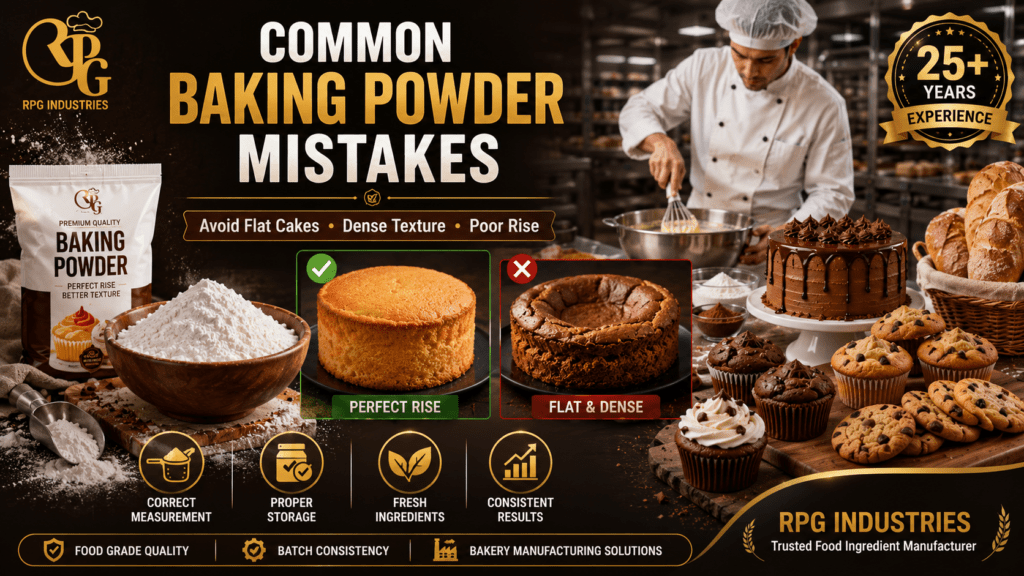
However, even small mistakes in how baking powder is used can lead to serious baking failures such as flat cakes, dense textures, bitter taste, or uneven rising. In both home baking and industrial bakery production, precision in baking powder usage directly determines product quality and consistency.
What Is Baking Powder and Why Is It Important?
Baking powder is a chemical leavening agent made from a combination of:
- Sodium bicarbonate (base)
- Acid salts (such as cream of tartar or phosphate compounds)
- Moisture-absorbing starch
How Baking Powder Works
When baking powder comes into contact with moisture and heat, it triggers a chemical reaction that releases carbon dioxide gas. These gas bubbles expand during baking, helping the batter rise and develop a soft structure.
This process is essential for:
- Cake rise and softness
- Muffin and biscuit texture
- Even crumb formation
- Light and airy baked goods
A properly functioning baking powder ensures consistent volume and texture across every batch.
What Are the Most Common Mistakes When Using Baking Powder?
Many baking failures are not caused by recipes but by incorrect use of baking powder.
Using Expired Baking Powder
One of the most common mistakes is using old or expired baking powder. Over time, it loses its ability to release gas effectively.
Effects include:
- Flat cakes and muffins
- Dense, heavy texture
- Poor rise in baked goods
Incorrect Measurement
Using too much or too little baking powder significantly affects baking results.
Too much baking powder causes:
- Bitter or metallic taste
- Over-expansion followed by collapse
- Large air holes in texture
Too little baking powder causes:
- Dense and heavy baked goods
- Poor volume
- Weak structure
Improper Mixing
If baking powder is not evenly distributed in the batter, it creates inconsistent rising.
Problems include:
- Uneven texture
- Air pockets in some areas
- Irregular crumb structure
Wrong Substitution with Baking Soda
Baking powder and baking soda are not interchangeable without adjustments.
Common issues:
- Chemical imbalance in batter
- Bitter or soapy taste
- Poor rise or collapse
Incorrect Storage
Baking powder is highly sensitive to moisture and air exposure.
Poor storage leads to:
- Loss of potency
- Reduced shelf life
- Weak leavening performance
What Happens If You Use Too Much Baking Powder?
Excess baking powder is one of the most damaging baking mistakes.
Effects on Texture
- Rapid rise followed by collapse
- Hollow or uneven crumb
- Structural instability
Effects on Taste
- Bitter or metallic flavor
- Unpleasant chemical aftertaste
Effects on Structure
- Weak internal bonding
- Cracked or broken surfaces
- Poor product stability
In industrial baking, overuse of baking powder can lead to entire batches being rejected due to quality failure.
Why Does Baking Powder Fail in Baking?
Baking powder may fail even when used correctly if other conditions are not met.
Expired or Weak Baking Powder
Aged baking powder produces insufficient carbon dioxide, resulting in poor or no rise.
Incorrect Oven Temperature
If the oven is too cold or too hot:
- Gas expansion becomes uneven
- Structure sets too early or too late
- Final product collapses or stays dense
Poor Mixing Technique
Improper mixing can prevent uniform activation of baking powder, leading to inconsistent baking results.
Most baking failures occur due to measurement errors, expired ingredients, or process inconsistencies rather than recipe design.
How Should Baking Powder Be Used Correctly?
Proper Measurement
- Use level measuring spoons or weighing scales
- Avoid excess or rounded measurements
- Follow formulation accuracy in industrial baking
Correct Mixing Method
- Sift baking powder with flour before mixing
- Ensure even distribution in dry ingredients
- Avoid overmixing after liquid addition
Timing of Usage
- Add baking powder to dry ingredients
- Bake immediately after mixing to retain gas activity
Delays between mixing and baking can reduce effectiveness.
Baking Powder vs Baking Soda – Common Mistakes
Many baking problems arise due to confusion between baking powder and baking soda.
Key Differences
- Baking powder: Complete leavening system (acid + base)
- Baking soda: Requires acidic ingredient to activate
Common Errors
- Using baking soda instead of baking powder
- Using baking powder without adjusting acidity levels
- Incorrect substitution ratios
Results of Mistakes
- Bitter taste
- Poor rise
- Dense or collapsed baked goods
Understanding this difference is essential for consistent baking performance.
How to Store Baking Powder Properly
Proper storage ensures long-lasting effectiveness.
Ideal Storage Conditions
- Keep in airtight containers
- Store in a cool, dry place
- Avoid exposure to humidity and heat
Shelf Life
Baking powder typically remains effective for several months, but best performance is achieved within 6–12 months of opening.
Signs of Expired Baking Powder
- No fizz in hot water test
- Weak rise in baked products
- Clumping due to moisture exposure
How Ingredient Quality Impacts Baking Performance
The quality of baking powder directly affects baking consistency, especially in commercial production environments.
Importance of Food-Grade Quality
High-quality baking powder ensures:
- Consistent gas release
- Stable baking reaction
- Predictable product rise
Supplier Consistency
In industrial baking, ingredient variation can cause:
- Batch-to-batch inconsistency
- Production inefficiency
- Quality failures
Reliable sourcing ensures uniform baking performance across large-scale production.
Industrial Baking Perspective: Why Mistakes Matter More at Scale
In industrial bakery production, even minor errors are amplified.
Batch Sensitivity
A small measurement error in baking powder can affect thousands of units in mass production.
Production Impact
- Product rejection
- Increased waste
- Higher operational costs
- Customer dissatisfaction
Quality Control Importance
Industrial bakeries rely on:
- Standardized formulations
- Ingredient testing
- Strict process control systems
Consistency is essential for maintaining brand reliability.
How RPG Industries Supports Consistent Baking Results
RPG Industries is a food ingredient manufacturer, supplier, and exporter with over 25 years of experience serving bakery and food manufacturing industries.
Bakery Ingredient Portfolio
- Baking Powder
- Corn Flour Powder
- Cocoa Powder
- Custard Powder
- Chocolate Chips
These ingredients are designed for industrial baking applications where consistency, performance, and food-grade quality are essential.
Manufacturing Quality Standards
- Food-grade raw material sourcing
- Standardized production processes
- Batch testing and quality control
- Hygienic manufacturing environments
Supply Reliability
- Bulk supply capability for industrial bakeries
- Pan-India distribution network
- Export-ready ingredient systems
- Flexible packaging options
RPG Industries supports manufacturers in achieving consistent baking performance through reliable and standardized ingredient supply systems.
Conclusion
Baking powder plays a critical role in determining the texture, volume, and quality of baked goods. Mistakes such as incorrect measurement, improper mixing, expired ingredients, or wrong substitutions can significantly impact baking results.
For both home bakers and industrial bakery manufacturers, understanding proper usage and ensuring ingredient quality is essential for achieving consistent, high-quality outcomes. In large-scale production, precision becomes even more important, as small errors can multiply across batches.
Consistent baking success depends on correct technique, proper storage, and reliable ingredient quality.
FAQs about Common Mistakes to Avoid When Using Baking Powder
What are common mistakes when using baking powder?
Common mistakes include using expired baking powder, incorrect measurement, improper mixing, wrong substitution with baking soda, and poor storage practices.
What happens if baking powder is expired?
Expired baking powder loses its leavening power, resulting in flat, dense, or poorly risen baked goods.
Can too much baking powder ruin a cake?
Explore Our Products Range
Choco Paste Manufacturer | Cocoa Powder Manufacturer | Butterscotch Crunch Manufacturer | Custard Powder Manufacturer | Baking Powder Manufacturer | Corn Flour Powder Manufacturer | Chocolate Syrup Manufacturer | Cake Decorating Sprinkle Manufacturer | Icing Sugar Powder Manufacturer | Chocolate Chips Manufacturer