
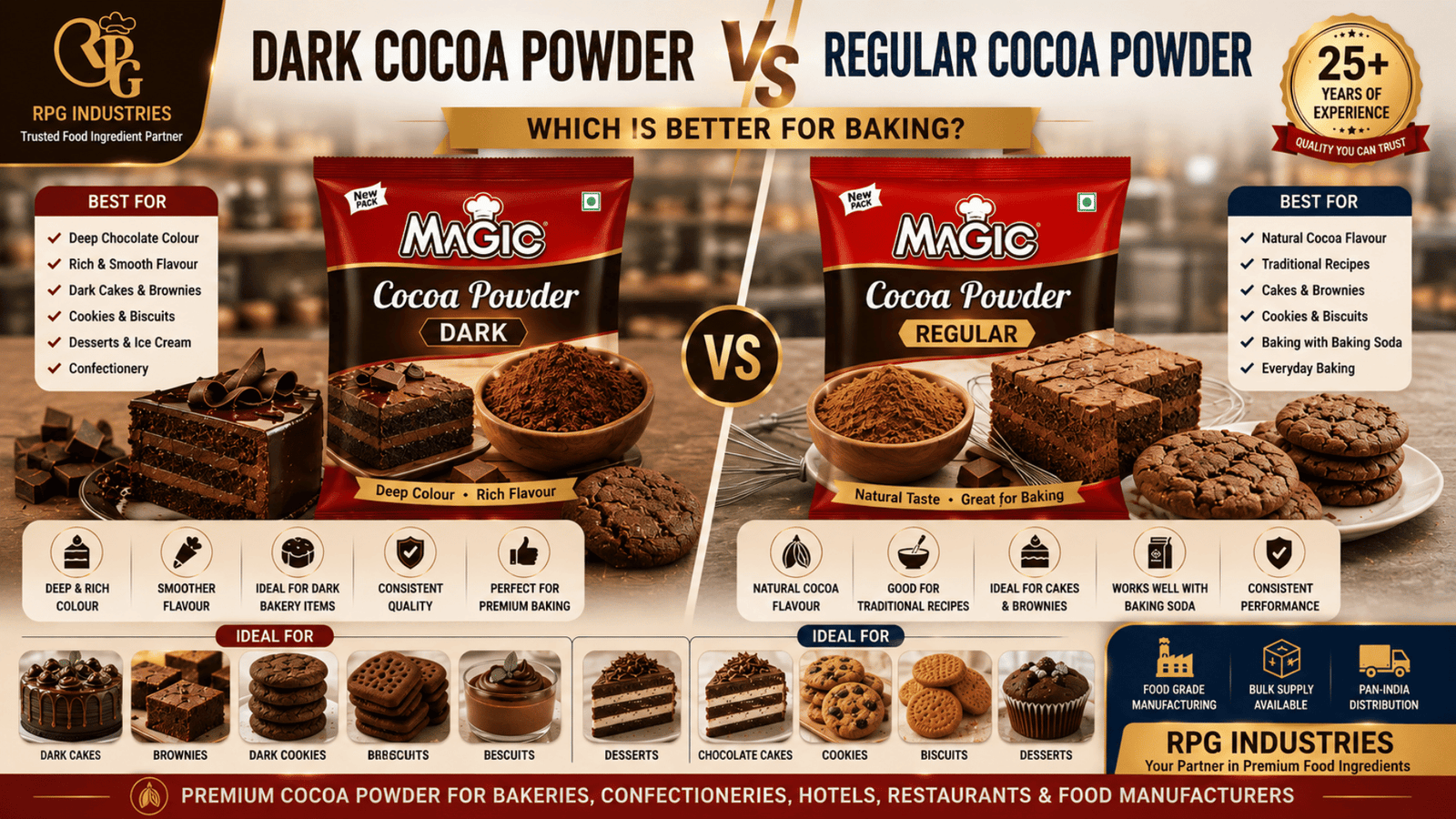
Quick Summary: Dark Cocoa Powder vs Regular Cocoa Powder
Dark cocoa powder and regular cocoa powder differ mainly in processing, colour, flavour, acidity and baking performance. Dark cocoa powder is often preferred when bakeries want a deeper chocolate colour and a specific flavour profile, while natural cocoa powder may be better suited to recipes that depend on cocoa’s natural acidity. For commercial baking, the right choice depends on the product, formulation, desired appearance and consistency requirements.
Dark Cocoa Powder vs Regular Cocoa Powder: Which Should Bakeries Choose?
Dark cocoa powder is not automatically better than regular cocoa powder. The better choice depends on the bakery product, formulation, desired colour, flavour profile, acidity and production requirements.
For example, a bakery producing dark chocolate cookies may prefer dark cocoa powder for its deeper colour, while a cake formulation developed around natural cocoa and baking soda may require a different cocoa specification.
For commercial bakeries, therefore, the most useful question is not simply “Which cocoa powder is better?” but “Which cocoa powder is better for my formulation?”
| Factor | Regular/Natural Cocoa Powder | Dark Cocoa Powder |
| Colour | Light to medium brown | Dark brown to very dark |
| Processing | Natural or less alkalized | Often associated with alkalized processing |
| Acidity | Generally higher when natural | Often lower when alkalized |
| Flavour | Distinctive cocoa character | Often deeper or smoother profile |
| Appearance | Traditional chocolate colour | Darker chocolate appearance |
| Baking behaviour | Depends on formulation | Depends on formulation |
| Common applications | Cakes, brownies, cookies, desserts | Dark cakes, cookies, biscuits, desserts |
The exact characteristics can vary by cocoa origin, grade, processing method and supplier specification.
What Is Regular Cocoa Powder?
“Regular cocoa powder” is a broad term commonly used by consumers and buyers. From a technical perspective, it is important to distinguish between natural cocoa powder and alkalized cocoa powder.
What Is Natural Cocoa Powder?
Natural cocoa powder retains more of cocoa’s natural acidity and has a characteristic cocoa flavour and colour. It is widely used in cakes, brownies, cookies, biscuits, confectionery and dessert formulations.
Its acidity can also influence recipes that use baking soda. In these formulations, the relationship between cocoa acidity and the leavening system can affect the final product’s rise, texture and structure.
What Is Regular Cocoa Powder Used For?
Commercial bakeries use cocoa powder across a wide range of products, including:
- Chocolate cakes
- Brownies
- Cookies
- Biscuits
- Frostings
- Fillings
- Desserts
- Confectionery products
- Chocolate beverages
- Ice-cream and frozen desserts
The most suitable cocoa powder depends on the formulation and finished-product requirements.
What Is Dark Cocoa Powder?
Dark cocoa powder is a cocoa ingredient selected primarily for its deeper colour and distinctive flavour characteristics. Many dark cocoa products are produced using alkalization, although the degree of processing can vary between products.
Alkalization can change cocoa’s acidity, colour, flavour and other functional characteristics. This is why commercial bakeries should evaluate the technical specification rather than choosing a product based only on the word “dark.”
What Is Dark Cocoa Powder Used For?
Dark cocoa powder can be used in:
- Chocolate cakes
- Brownies
- Dark chocolate cookies
- Biscuits
- Frostings
- Dessert products
- Confectionery
- Ice cream
- Chocolate-based commercial formulations
Its deeper colour can be particularly useful when appearance is an important part of the finished product.
Is Dark Cocoa Powder Better Than Regular Cocoa Powder?
No. Dark cocoa powder is not universally better than regular cocoa powder. It is better suited to certain applications.
Choose Dark Cocoa Powder When:
- A deep chocolate colour is important
- The product is designed around a dark chocolate appearance
- You are producing dark cookies or biscuits
- A particular processed cocoa flavour is required
- The formulation is compatible with the cocoa’s acidity and processing characteristics
Consider Regular or Natural Cocoa When:
- A traditional cocoa flavour is preferred
- The recipe relies on cocoa’s natural acidity
- A lighter chocolate colour is acceptable
- The existing formulation was developed specifically around natural cocoa
This distinction is particularly important for commercial bakery production, where even a small ingredient change can affect consistency across multiple batches.
Does Dark Cocoa Powder Affect Baking?
Yes, changing from natural cocoa powder to a darker or alkalized cocoa powder can affect baking performance.
The main reason is acidity.
Natural cocoa is generally more acidic, while alkalized cocoa has reduced acidity. If a recipe depends on the interaction between cocoa and baking soda, changing the cocoa type can alter the formulation’s acid-base balance.
This may influence:
- Product rise
- Crumb structure
- Texture
- Colour
- Flavour
- Overall consistency
For this reason, commercial bakeries should test a cocoa substitution before making a production-wide formulation change.
Dark Cocoa Powder vs Regular Cocoa Powder for Cakes
Dark cocoa powder is generally preferred when a bakery wants a deeper chocolate colour, while natural cocoa may be preferable when the recipe requires its characteristic acidity and cocoa flavour.
For commercial chocolate cakes, bakeries should consider:
- Desired cake colour
- Cocoa flavour
- Cocoa type
- pH and acidity
- Leavening system
- Fat content
- Recipe balance
- Batch consistency
Which Cocoa Powder Gives Cakes a Darker Colour?
Dark cocoa powder generally produces a deeper chocolate colour than natural cocoa powder.
However, final colour depends on more than cocoa type. The amount of cocoa used, other ingredients, baking conditions and the specific cocoa grade can all affect the finished appearance.
Dark Cocoa Powder vs Regular Cocoa Powder for Brownies
Dark cocoa powder can be an excellent choice for brownies when a deeper chocolate appearance is desired.
Regular cocoa powder can also work well when the bakery wants a more traditional cocoa profile.
For commercial brownie production, the decision should be based on the complete formulation rather than colour alone. Cocoa type can influence flavour, acidity, texture and finished appearance.
Which Cocoa Powder Is Better for Cookies and Biscuits?
Dark cocoa powder is particularly useful for cookies and biscuits where a strong, dark chocolate appearance is part of the product identity.
It can be considered for:
- Dark chocolate cookies
- Chocolate sandwich biscuits
- Premium chocolate biscuits
- Dark-coloured bakery products
Regular cocoa powder may be preferable for products requiring a lighter appearance or a more traditional natural cocoa profile.
Natural Cocoa vs Alkalized Cocoa vs Dark Cocoa
These three terms are related but should not be treated as interchangeable.
| Cocoa Type | Main Characteristic | Key Bakery Consideration |
| Natural Cocoa | Naturally acidic | Important for formulations using baking soda |
| Alkalized Cocoa | Reduced acidity through processing | Can provide different colour and flavour characteristics |
| Dark Cocoa | Deeper colour; processing varies | Useful for dark-coloured products |
Is Dark Cocoa Powder the Same as Alkalized Cocoa Powder?
Not necessarily.
“Alkalized” describes a processing method, whereas “dark cocoa” generally describes a cocoa product with a darker colour and associated characteristics.
Many dark cocoa powders are alkalized, but products can differ significantly in pH, colour, fat content, flavour and processing level.
For commercial procurement, bakeries should always review the supplier’s technical specification sheet instead of relying only on product naming.
Can Bakeries Replace Regular Cocoa Powder With Dark Cocoa Powder?
Sometimes, but dark cocoa powder should not automatically be substituted for regular cocoa powder at a 1:1 ratio.
A change in cocoa type can affect:
- pH
- Leavening
- Colour
- Flavour
- Texture
- Fat contribution
- Recipe balance
For commercial production, the safest approach is to conduct controlled product trials and compare the finished results before changing the production specification.
How Should Commercial Bakeries Choose Cocoa Powder?
Choosing cocoa powder for commercial production requires more than comparing price per kilogram.
1. Consider the Application
Identify whether the cocoa is intended for cakes, brownies, cookies, biscuits, confectionery, ice cream or beverages.
2. Define the Desired Colour
Decide whether the final product needs a light, medium or deep chocolate appearance.
3. Evaluate Flavour
Consider whether the product requires a pronounced natural cocoa profile or a darker, smoother chocolate character.
4. Check pH and Acidity
This is particularly important for recipes using baking soda or other chemical leavening systems.
5. Compare Fat Content
Different cocoa powders can have different fat specifications, which can affect formulation and processing.
6. Check Batch Consistency
Commercial bakeries need consistent colour, flavour and performance from batch to batch.
7. Evaluate Packaging and Supply
Bulk buyers should consider packaging formats, storage requirements, minimum order quantities and recurring supply capability.
8. Review Quality Documentation
Product specifications, food-grade manufacturing information, quality documentation and relevant compliance records can help procurement teams make informed decisions.
What Is the Best Cocoa Powder for Commercial Baking?
There is no single cocoa powder that is best for every commercial bakery product.
The best cocoa powder is the one that consistently meets the product’s required:
- Colour
- Flavour
- Acidity
- Fat content
- Processing characteristics
- Texture requirements
- Batch consistency
For example, a bakery making dark chocolate cookies may prioritise colour, while a cake manufacturer may place greater emphasis on flavour and leavening compatibility.
Where Can Bakeries Buy Bulk Cocoa Powder in India?
Commercial bakeries looking for bulk cocoa powder in India should evaluate manufacturers and B2B suppliers based on both product quality and supply capability.
Important factors include:
- Cocoa type and grade
- Colour specification
- pH
- Fat content
- Flavour
- Batch consistency
- Packaging options
- Quality documentation
- Bulk availability
- Delivery capability
For large-scale production, reliable and consistent supply can be as important as the initial product specification.
How RPG Industries Fits Into Commercial Cocoa Ingredient Supply
RPG Industries is an India-based food ingredients manufacturer serving professional bakeries, ice-cream businesses, confectionery manufacturers, HORECA businesses and commercial food manufacturers.
Its cocoa ingredient range includes cocoa powder, dark cocoa powder and alkalized cocoa powder, with applications across bakery and confectionery products.
For a bakery evaluating different cocoa grades, the important consideration remains the same: the cocoa specification should match the formulation, finished-product requirements and production process.
This makes technical specifications and application suitability more useful decision factors than simply choosing the darkest or lowest-priced cocoa powder.
Dark Cocoa Powder vs Regular Cocoa Powder: Which Should Bakeries Choose?
The following decision guide can help commercial bakeries make a quicker comparison:
| Bakery Requirement | Better Starting Point |
| Deeper chocolate colour | Dark cocoa powder |
| Natural cocoa acidity | Natural cocoa powder |
| Dark chocolate cookies | Dark cocoa powder |
| Dark biscuits | Dark cocoa powder |
| Recipe developed around natural cocoa | Natural cocoa powder |
| Formulation dependent on cocoa acidity | Check natural cocoa suitability |
| Established commercial recipe | Match the existing cocoa specification |
| New product development | Compare multiple cocoa grades |
| Bulk commercial production | Evaluate technical specifications and consistency |
The key takeaway is simple: choose cocoa powder according to the formulation and application, not simply according to how dark the powder looks.
Conclusion: Dark Cocoa Powder vs Regular Cocoa Powder
Dark cocoa powder and regular cocoa powder both have an important role in commercial baking, but they are not interchangeable in every application.
Dark cocoa powder is often a strong choice for products where deep chocolate colour, visual appeal and a particular flavour profile are important. Natural cocoa powder can be more suitable for formulations that depend on natural cocoa acidity, traditional cocoa flavour or an established recipe balance.
For commercial bakeries, the decision should go beyond colour and price. Factors such as pH, acidity, fat content, flavour, processing, formulation compatibility and batch consistency can directly influence the finished product.
Before switching from one cocoa grade to another, conduct controlled product trials and compare the results against your existing formulation.
Ultimately, the best cocoa powder for a bakery is the one that delivers consistent colour, flavour and performance at the required commercial scale.
FAQs about Dark Cocoa Powder vs Regular Cocoa Powder
What is the difference between dark cocoa powder and regular cocoa powder?
Dark cocoa powder is generally darker and often associated with alkalized processing, while regular or natural cocoa powder usually has a lighter colour and higher natural acidity. Exact characteristics depend on the cocoa grade and processing method.
Is dark cocoa powder better than regular cocoa powder for baking?
No. Dark cocoa powder is not universally better for baking. It is particularly useful when a deeper chocolate colour is required, while natural cocoa may be better for recipes that rely on its acidity.
Can dark cocoa powder replace regular cocoa powder?
Sometimes, but it should not automatically be substituted 1:1. Differences in acidity, colour, flavour and processing can change the finished product, so commercial formulations should be tested first.
Which cocoa powder is best for commercial bakeries?
The best cocoa powder depends on the bakery’s product and formulation. Commercial buyers should compare colour, flavour, pH, fat content, consistency, application performance and supply reliability.
What should bakeries check when buying cocoa powder in bulk?
Bakeries should check cocoa type, pH, fat content, colour, flavour, consistency, packaging, documentation and supply capability. These factors help determine whether a cocoa powder will perform consistently in commercial production.
Explore RPG Industries Products Range
Choco Paste Manufacturer | Cocoa Powder Manufacturer | Butterscotch Crunch Manufacturer | Custard Powder Manufacturer | Baking Powder Manufacturer | Corn Flour Powder Manufacturer | Chocolate Syrup Manufacturer | Cake Decorating Sprinkle Manufacturer | Icing Sugar Powder Manufacturer | Chocolate Chips Manufacturer