
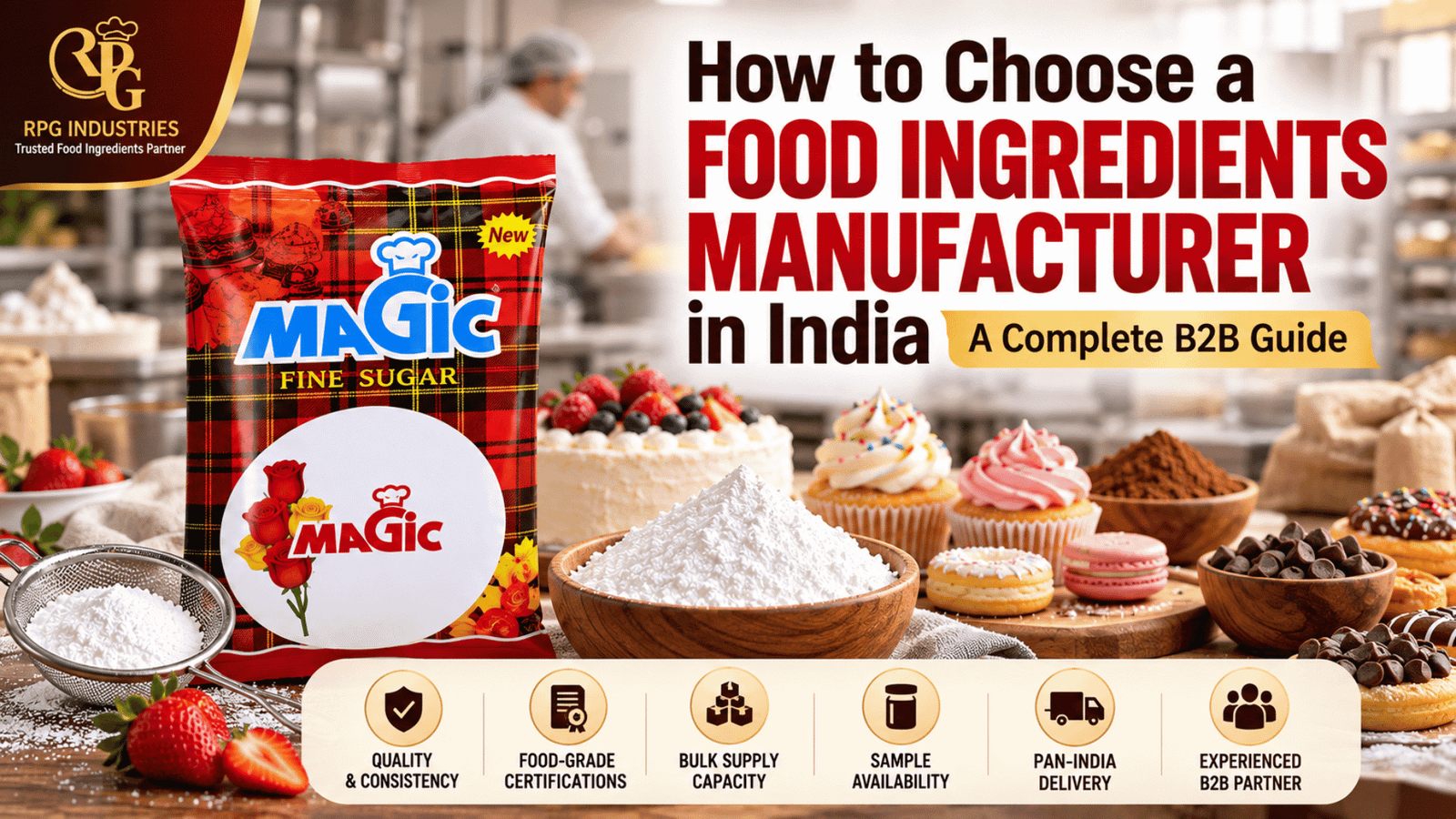
How to Choose a Food Ingredients Manufacturer in India: A Complete B2B Guide
Choosing a food ingredients manufacturer in India requires more than comparing prices. B2B buyers should evaluate product quality, food-safety compliance, manufacturing capability, batch consistency, documentation, samples, bulk-supply capacity, packaging, delivery reliability, and application suitability.
For bakeries, ice-cream manufacturers, confectionery businesses, FMCG companies, HORECA businesses, and food processors, the right manufacturer should provide consistent ingredients and reliable supply at the required commercial scale.
What Should You Look for in a Food Ingredients Manufacturer in India?
A reliable food ingredients manufacturer should be evaluated on:
- Manufacturing capability
- Product specifications
- Food-safety compliance
- Quality-control processes
- Batch consistency
- Sample availability
- Bulk-supply capacity
- Packaging options
- Minimum order quantity
- Delivery capability
- Industry experience
- Customer support
- Documentation
The lowest price is not always the lowest overall procurement cost. Quality, consistency, supply reliability, and application performance also affect the cost of commercial food production.
How Do You Know Whether a Company Is Actually a Manufacturer?
Before placing a bulk order, determine whether the company is a manufacturer, distributor, wholesaler, importer, or supplier.
A manufacturer produces the ingredient through its own manufacturing operation, while a distributor or wholesaler generally purchases products and resells them.
For B2B buyers, knowing the supplier’s role helps when discussing:
- Product specifications
- Quality requirements
- Batch information
- Manufacturing capacity
- Packaging
- Recurring orders
- Technical requirements
Direct manufacturer relationships can be particularly useful for businesses with regular or high-volume ingredient requirements.
What Product Specifications Should You Check?
A food ingredient specification describes the characteristics and requirements of a particular product.
Depending on the ingredient, buyers may need to check:
- Product grade
- Appearance
- Colour
- Texture
- Particle size
- Moisture
- Solubility
- pH
- Fat content
- Microbiological requirements
- Shelf life
- Storage conditions
- Packaging
- Application suitability
- Allergen information, where applicable
Specifications should be evaluated according to the intended application.
For example, cocoa powder required for bakery products may have different performance requirements from cocoa powder used in an ice-cream formulation.
What Food-Safety Documents Should a Manufacturer Provide?
B2B food buyers should verify the food-safety and regulatory documentation applicable to the product and market.
Depending on the ingredient, buyers may request:
- FSSAI licence or applicable food-safety certification
- Product specification sheet
- Certificate of Analysis (COA), where applicable
- Batch information
- Allergen information
- Shelf-life information
- Storage requirements
- Ingredient declaration
- Relevant regulatory documents
- Export documentation, where required
Documentation helps procurement, quality-control, and R&D teams evaluate and approve ingredients before commercial use.
Why Is Batch Consistency Important?
Batch consistency means that an ingredient performs predictably from one production batch to another.
Variations in colour, texture, moisture, flavour, particle size, solubility, or other characteristics can affect the finished food product.
For commercial manufacturers, consistent ingredients can help maintain:
- Taste
- Texture
- Colour
- Appearance
- Processing performance
- Finished-product quality
Batch consistency is particularly important for FMCG manufacturers and businesses producing the same product at commercial scale.
Should You Request a Sample Before Buying in Bulk?
Yes. When samples are available, B2B buyers should evaluate an ingredient before committing to a large commercial order.
A sample can be tested for:
- Appearance
- Colour
- Aroma
- Taste
- Texture
- Solubility
- Processing performance
- Compatibility with the existing formulation
- Finished-product performance
The most useful test is usually an application trial, where the ingredient is tested in the actual recipe or manufacturing process.
A practical process is:
Sample → Application Trial → Quality Approval → Commercial Evaluation → Bulk Order
How Should You Evaluate Bulk Supply Capability?
A manufacturer should be able to support your current requirements and, where applicable, future demand.
Ask about:
- Minimum order quantity
- Packaging sizes
- Production capacity
- Lead time
- Recurring-order capability
- Supply availability
- Delivery coverage
- Export capability
- Custom requirements, where applicable
Packaging should match the buyer’s consumption, storage capacity, shelf-life requirements, and production volume.
How Important Is Delivery Reliability?
Delivery reliability is important because ingredient shortages can interrupt commercial production.
Before selecting a supplier, consider:
- Lead times
- Delivery locations
- Dispatch reliability
- Recurring-order capability
- Logistics support
- Packaging protection
- Communication during order processing
For businesses operating on fixed production schedules, consistent supply can be as important as the ingredient’s purchase price.
Should You Choose a Supplier Based on Price Alone?
No. Price should be evaluated together with quality, consistency, supply reliability, and total procurement cost.
A useful B2B evaluation is:
Total procurement cost = Product price + Logistics + Quality-related costs + Waste + Supply risk
A lower-priced ingredient may become more expensive if it causes:
- Production waste
- Batch rejection
- Reformulation
- Processing problems
- Delayed production
- Emergency purchases
The objective should be to find the right balance between price, quality, performance, and supply reliability.
How Should You Compare Food Ingredients Manufacturers?
Use the same criteria when evaluating different suppliers.
| Evaluation Factor | What to Check |
| Product quality | Does it meet your required specification? |
| Food safety | Are relevant documents available? |
| Consistency | Is batch performance controlled? |
| Manufacturing | Is the company a manufacturer? |
| Capacity | Can it support your required volume? |
| MOQ | Does the minimum order suit your business? |
| Packaging | Are suitable pack sizes available? |
| Application | Does the ingredient perform in your formulation? |
| Delivery | Can the supplier reliably deliver to your location? |
| Documentation | Are required technical documents available? |
| Support | Is responsive B2B support available? |
| Price | Is the total procurement cost competitive? |
Which Food Ingredient Manufacturer Is Suitable for Different Businesses?
Different businesses have different procurement requirements.
| Business Type | Key Requirements |
| Commercial bakery | Consistency, application performance, packaging and delivery |
| Cake manufacturer | Colour, texture, decoration performance and consistency |
| Ice-cream manufacturer | Flavour, texture, formulation performance and bulk supply |
| Confectionery manufacturer | Inclusions, texture, flavour and supply consistency |
| FMCG company | Specifications, documentation, capacity and consistency |
| Hotels and restaurants | Pack sizes, quality, availability and ease of use |
| Catering companies | Bulk packaging, reliability and delivery |
| Food processors | Specifications, recurring supply and documentation |
| Distributors | Product range, packaging and availability |
| Export buyers | Specifications, documentation, packaging and logistics |
What Questions Should You Ask a Food Ingredients Manufacturer?
Before placing a commercial order, ask:
- Are you the manufacturer or distributor?
- What are the product specifications?
- What food-safety documents are available?
- Can I request a product sample?
- What is the minimum order quantity?
- What packaging sizes are available?
- What is the expected lead time?
- Can you support recurring orders?
- Do you supply businesses in my industry?
- What customer support is available after the order?
These questions help buyers identify potential supply and quality issues before committing to a large order.
What Is the Best Way to Qualify a New Food Ingredient Manufacturer?
A practical supplier-qualification process is:
Requirement → Shortlist → Documentation → Sample → Application Trial → Commercial Evaluation → Order → Performance Review
Step 1: Define Your Requirement
Specify:
- Ingredient
- Application
- Required quantity
- Packaging
- Quality requirements
- Delivery location
- Ordering frequency
Step 2: Shortlist Manufacturers
Identify manufacturers that supply the required ingredient and serve your industry.
Step 3: Review Documentation
Check specifications, food-safety documents, quality information, and other applicable documentation.
Step 4: Request a Sample
Request a sample where application testing is necessary.
Step 5: Conduct an Application Trial
Test the ingredient in the actual recipe or manufacturing process.
Step 6: Compare Commercial Terms
Compare:
- Price
- MOQ
- Packaging
- Lead time
- Delivery
- Payment terms
Step 7: Place a Commercial Order
Once the technical and commercial requirements are satisfied, place an appropriate order.
Step 8: Monitor Supplier Performance
Review:
- Product consistency
- Batch performance
- Delivery reliability
- Documentation
- Customer support
- Supply continuity
Why Choose RPG Industries for Food Ingredients in India?
RPG Industries is a Delhi-based B2B food ingredients manufacturer and bulk supplier serving bakeries, ice-cream manufacturers, confectionery businesses, FMCG brands, HORECA businesses, and other food businesses.
The company has more than 25 years of experience in food ingredient manufacturing and supplies food-grade ingredients for commercial applications.
RPG Industries focuses on:
- Bulk food ingredient supply
- Bakery ingredients
- Ice-cream ingredients
- Confectionery ingredients
- Cake decoration ingredients
- HORECA ingredients
- FMCG ingredient supply
- Pan-India distribution
- International export supply
What Food Ingredients Does RPG Industries Supply?
RPG Industries offers ingredients for bakery, ice-cream, confectionery, and commercial food applications, including:
Bakery Ingredients
- Baking Powder
- Cocoa Powder
- Custard Powder
- Chocolate Chips
- Corn Flour Powder
- Chocolate Dressing
- Fine Sugar Powder
- Drinking Chocolate Powder
- Cake Decorating Sprinkles
- Sugar Paste/Fondant
Ice-Cream Ingredients
- Choco Paste
- Dark Choco Paste
- Cocoa Powder
- Custard Powder
- Butterscotch Crunch
- Chocolate Dressing
Confectionery Ingredients
- Chocolate Chips
- Chocolate Vermicelli
- Chocolate Sprinkles
- Chocolate Strands
- Butterscotch Nuts
Who Can Buy Food Ingredients from RPG Industries?
RPG Industries serves B2B customers including:
- Professional bakeries
- Commercial bakers
- Cake manufacturers
- Ice-cream manufacturers
- Confectionery manufacturers
- FMCG brands
- Hotels
- Restaurants
- Cafes
- Catering companies
- Food processors
- Distributors
- Wholesalers
- Export buyers
Food Ingredient Manufacturer Selection Checklist
Before choosing a manufacturer, confirm:
- Required ingredient and application
- Manufacturer or distributor status
- Product specifications
- Food-safety documentation
- Sample availability
- Application-test results
- Batch consistency
- MOQ
- Packaging
- Production capacity
- Delivery capability
- Lead time
- Total procurement cost
- Customer support
- Long-term supply capability
Looking for a Food Ingredients Manufacturer in India?
RPG Industries manufactures and supplies food-grade ingredients for bakeries, ice-cream manufacturers, confectionery businesses, FMCG companies, HORECA businesses, and other commercial food businesses.
With 25+ years of experience, bulk-supply capability, pan-India delivery, and export readiness, RPG Industries provides food ingredient solutions for professional and commercial applications.
For bulk requirements, samples, or quotations, contact RPG Industries with your ingredient name, required quantity, application, and delivery location.