
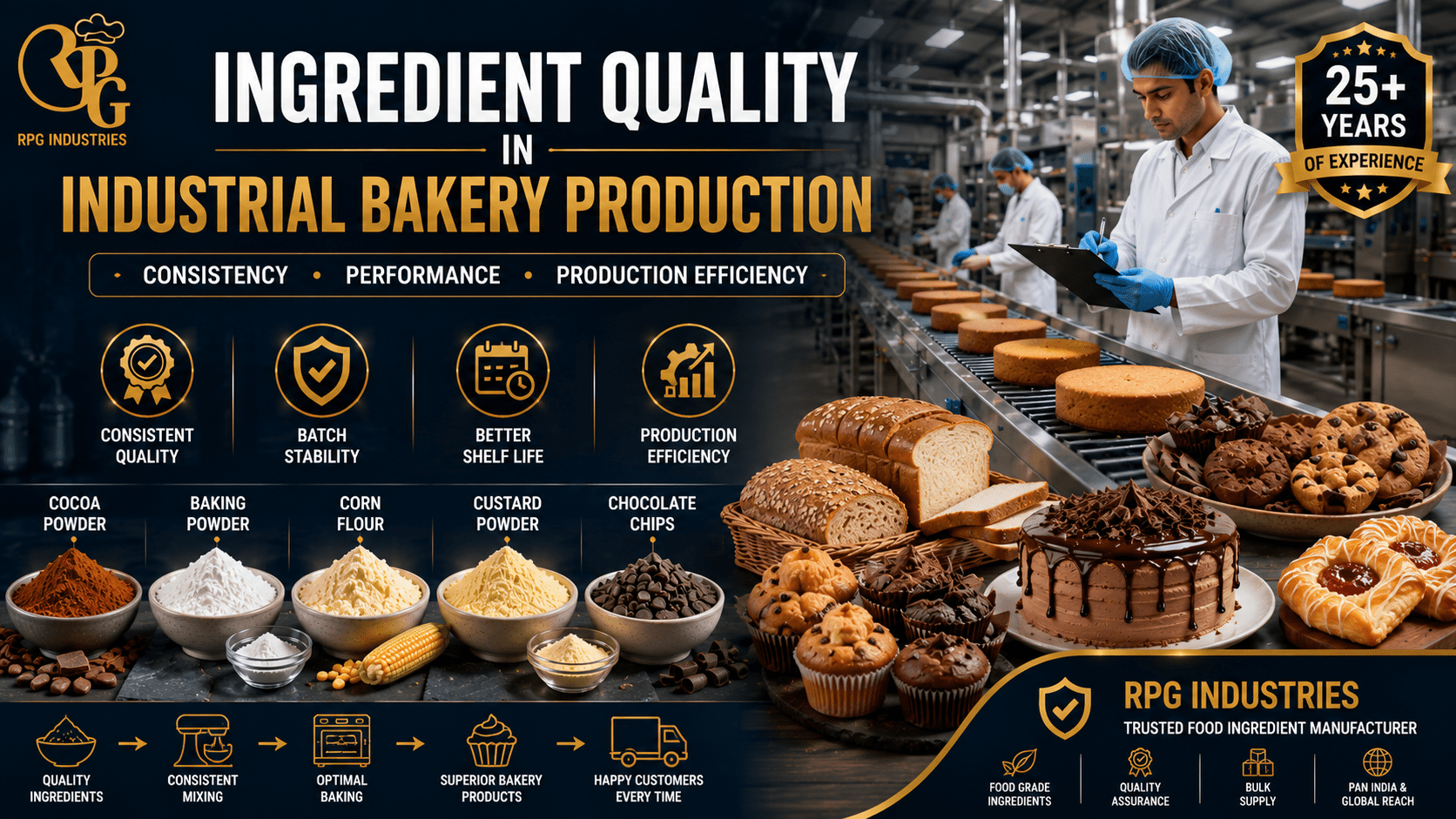
The Role of Ingredient Quality in Industrial Bakery Production
Opening: Why Ingredient Quality Defines Industrial Bakery Success
Ingredient quality in industrial bakery production determines how consistently a bakery can produce products at scale. It directly affects dough behavior, texture, flavor stability, shelf life, production efficiency, and overall product reliability.
In large-scale baking systems, ingredients such as flour, baking powder, cocoa powder, emulsifiers, enzymes, and functional additives are not just raw materials—they are performance systems. Even small variations in ingredient quality can lead to major differences in dough handling, oven performance, product volume, and final texture.
Industrial bakery production depends on one core principle: consistent inputs create consistent outputs.
What Is Industrial Bakery Production?
Industrial bakery production refers to large-scale, automated, and standardized baking operations designed to produce high volumes of bakery products such as bread, cakes, biscuits, buns, and pastries.
Key Characteristics of Industrial Baking
- High-volume automated production lines
- Standardized recipes and formulations
- Continuous mixing and baking systems
- Strict quality control protocols
- Bulk ingredient usage
Unlike artisanal baking, where small variations are acceptable, industrial baking demands absolute consistency. This makes ingredient quality a critical success factor.
Why Ingredient Quality Matters in Industrial Bakery Production
Ingredient quality is the foundation of predictable bakery performance. Every ingredient interacts with others during mixing, fermentation, and baking, influencing final product structure and stability.
How Ingredient Quality Impacts Production
- Ensures consistent dough elasticity and extensibility
- Maintains uniform product texture and softness
- Improves flavor stability across batches
- Reduces production errors and waste
- Enhances shelf life and freshness
A single variation in flour strength or emulsifier performance can disrupt the entire production line, leading to inconsistent results.
Citation-Worthy Insight
Ingredient quality directly determines dough behavior during mixing, fermentation, baking, and cooling stages in industrial bakery systems, making it one of the most important factors in large-scale food manufacturing.
What Are the Key Ingredients Used in Industrial Bakery Manufacturing?
Industrial bakery production uses a combination of structural, functional, and sensory ingredients.
Structural Ingredients
These form the base of bakery products:
- Wheat flour
- Sugar systems
- Fats and oils
- Water
Functional Ingredients
These improve processing efficiency and product performance:
- Baking powder
- Emulsifiers
- Enzymes
- Dough conditioners
- Hydrocolloids
Flavor and Appearance Ingredients
These enhance sensory appeal:
- Cocoa powder
- Chocolate chips
- Custard powder
- Flavor systems
- Decorative inclusions
Each category plays a specific role in ensuring stability, texture, and consumer appeal.
How Flour Quality Impacts Industrial Bakery Production
Flour is the most important structural ingredient in bakery manufacturing. It determines dough strength, elasticity, and gas retention.
Flour as the Structural Backbone
Flour controls gluten formation, which defines:
- Dough elasticity
- Stretchability
- Volume expansion
- Crumb structure
Key Flour Quality Parameters
- Protein content
- Water absorption capacity
- Gluten strength
- Ash content
- Particle consistency
Why Consistency Matters
In automated production systems, inconsistent flour quality can cause:
- Dough instability
- Uneven mixing
- Poor fermentation
- Product rejection
Consistent flour ensures smooth machine operation and predictable results.
Role of Functional Ingredients in Bakery Manufacturing
Functional ingredients are essential for improving dough performance and production efficiency.
What Are Functional Ingredients?
These include:
- Emulsifiers
- Enzymes
- Dough conditioners
- Hydrocolloids
How Emulsifiers Improve Baking
Emulsifiers stabilize fat and water systems in dough, leading to:
- Better texture
- Increased loaf volume
- Improved softness
- Longer shelf life
How Enzymes Improve Production
Enzymes enhance:
- Dough tolerance during mixing
- Fermentation control
- Bread softness
- Shelf-life extension
These ingredients allow manufacturers to maintain consistent output even under varying production conditions.
How Ingredient Quality Affects Dough Performance
Dough performance is a direct reflection of ingredient quality.
Mixing Behavior
High-quality ingredients ensure:
- Uniform hydration
- Stable gluten development
- Predictable dough consistency
Fermentation Performance
Ingredient quality affects:
- Yeast activity
- Gas retention
- Volume expansion
Baking Response
During baking, quality ingredients ensure:
- Even crust formation
- Proper moisture retention
- Stable internal structure
Poor-quality ingredients often lead to collapsed, dense, or inconsistent bakery products.
Why Batch-to-Batch Consistency Is Critical
Industrial bakery production requires repeatability. Every batch must perform exactly like the previous one.
Causes of Batch Variation
- Raw material inconsistency
- Supplier quality differences
- Storage and handling issues
Impact of Inconsistency
- Production downtime
- Increased waste
- Product rejection
- Brand inconsistency
Control Measures
Manufacturers reduce variability through:
- Strict supplier qualification
- Ingredient testing protocols
- Standardized procurement systems
How Ingredient Quality Impacts Shelf Life
Shelf life is a key commercial factor in bakery products.
Moisture Retention
Good-quality ingredients help maintain moisture balance, preventing dryness and staling.
Structural Stability
Emulsifiers and enzymes improve:
- Softness retention
- Texture stability
- Product freshness over time
Shelf-Life Extension
Functional ingredients slow down degradation, ensuring longer product usability in retail distribution.
Role of Cocoa Powder and Chocolate Ingredients in Bakery Production
Cocoa powder and chocolate-based ingredients are widely used in industrial bakery applications.
Cocoa Powder
Cocoa powder provides:
- Rich chocolate flavor
- Consistent color
- Aroma enhancement
- Premium product positioning
Chocolate Chips and Inclusions
These improve:
- Texture contrast
- Visual appeal
- Consumer experience
- Product differentiation
In industrial baking, ingredient consistency is especially important for achieving uniform chocolate distribution.
Industrial Bakery Quality Control Systems
Quality control ensures ingredient performance translates into consistent products.
Ingredient Testing
Before production, ingredients undergo:
- Moisture analysis
- Protein testing
- Functional evaluation
Process Monitoring
During production:
- Dough consistency is monitored
- Temperature is controlled
- Mixing and fermentation are tracked
Final Product Testing
Finished products are evaluated for:
- Texture
- Volume
- Taste
- Shelf life stability
Common Problems Caused by Poor Ingredient Quality
Poor ingredient quality can lead to serious production issues:
- Weak dough structure
- Uneven product size
- Poor texture and mouthfeel
- Reduced shelf life
- Production inefficiency
- High rejection rates
These problems directly impact profitability and brand reputation.
How RPG Industries Supports Industrial Bakery Production
RPG Industries is a food ingredient manufacturer, supplier, and exporter with over 25 years of experience serving industrial bakery and food manufacturing businesses.
Bakery Ingredient Portfolio
- Baking Powder
- Corn Flour Powder
- Cocoa Powder
- Chocolate Chips
- Custard Powder
- Sugar-based systems
Quality Manufacturing Standards
- Food-grade raw materials
- Standardized production systems
- Batch consistency assurance
- Hygienic manufacturing processes
Supply Capabilities
- Bulk supply for industrial bakeries
- Pan-India distribution network
- Export-ready ingredient systems
- Flexible packaging options
RPG Industries supports manufacturers in achieving consistent production performance through reliable, standardized ingredient supply systems.
Conclusion
Ingredient quality is the backbone of industrial bakery production. From flour and sugar systems to emulsifiers, enzymes, cocoa powder, and functional additives, every ingredient directly influences production efficiency, dough behavior, and final product quality.
Manufacturers that prioritize consistent, food-grade ingredients achieve better stability, higher efficiency, and stronger product reliability. In a competitive bakery industry, ingredient quality is not just a requirement—it is a strategic advantage.
FAQs about The Role of Ingredient Quality in Industrial Bakery Production
Why is ingredient quality important in industrial bakery production?
Ingredient quality ensures consistent dough behavior, product texture, shelf life, and production efficiency in large-scale bakery manufacturing.
How does flour quality affect bakery products?
Flour quality determines gluten development, dough elasticity, volume, and final product structure.
What are functional ingredients in bakery manufacturing?
Functional ingredients include emulsifiers, enzymes, and dough conditioners that improve processing and product performance.
Explore Our Products Range
Choco Paste Manufacturer | Cocoa Powder Manufacturer | Butterscotch Crunch Manufacturer | Custard Powder Manufacturer | Baking Powder Manufacturer | Corn Flour Powder Manufacturer | Chocolate Syrup Manufacturer | Cake Decorating Sprinkle Manufacturer | Icing Sugar Powder Manufacturer | Chocolate Chips Manufacturer